Exercise is a stimulus for good health, strong bones, the development of muscle strength, fitness and co-ordination.
This is a form of exercise that is sustainable for longer periods sometimes referred to as ‘cardio’. Examples are walking, running, cycling, and swimming.
Moderate Aerobic activity: raises your heart rate and makes you sweat. But you can still talk and even sing!
Vigorous Aerobic activity: raises the heart rate and you feel out of breath- you will not be able to sing.
*Individual physical and mental capabilities should be considered when interpreting the guidelines.
This is when we move our body against a resistance such our own body weight, an elastic band, or while lifting a weight.
“Children age 7-18 should participate in Resistance Training programmes at least twice weekly.”
— International consensus statement on Youth resistance training, 2014
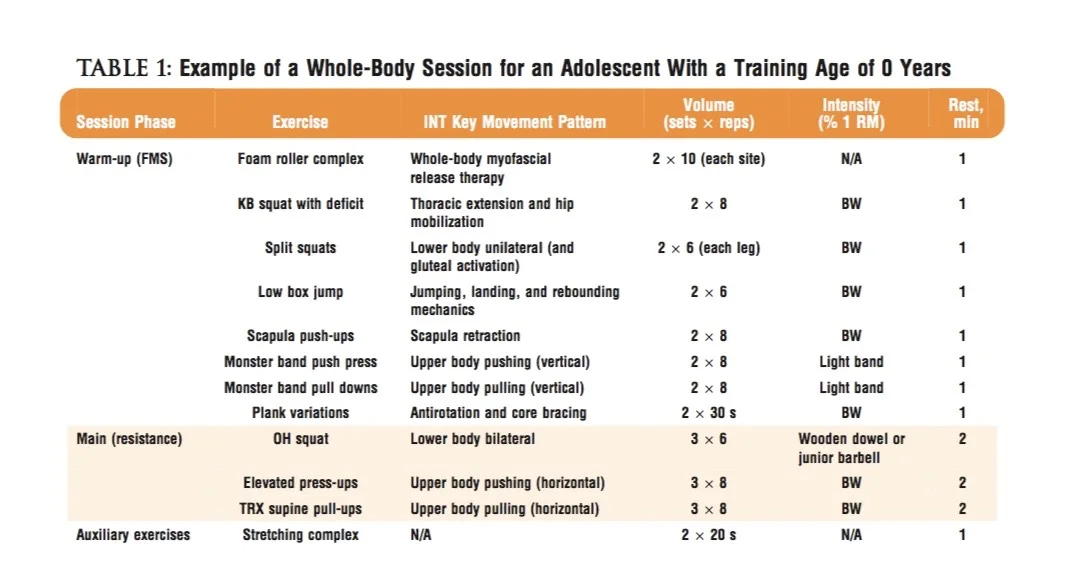
This is an example of a resistance training programme for an Adolescent (Age 12-18 for girls, 14-18 for boys) with no prior training experience. It is called Integrative Neuromuscular Training (INT).
The NHS choices website recommend
More information on the ‘window of nueromuscular’ development is discussed in my blog post ” does weight training in children stunt growth?”.
“The Push-ups, press-ups and resistance exercises need to be supervised to ensure correct technique and suitability for the child’s training age.”
More information on the ‘window of nueromuscular’ development is discussed in my blog post “does weight training in children stunt growth?“.
(DHSSPS), D. O. H. A. S. S. A. P. S. 2011. Start Active, Stay Active: A report on physical activity for health from the four home countries’ Chief Medical Officers
AUVINEN, J., TAMMELIN, T., TAIMELA, S., ZITTING, P. & KARPPINEN, J. 2008. Associations of physical activity and inactivity with low back pain in adolescents. Scand J Med Sci Sports, 18, 188-94.
CAREY, N. 2012. The Epigenetics Revolution: How modern biology is rewriting our understanding of genetics, disease and inheritance. Icon Books Ltd.
FAIGENBAUM, A. D., MILLIKEN, L. A., LOUD, R. L., BURAK, B. T., DOHERTY, C. L. & WESTCOTT, W. L. 2002. Comparison of 1 and 2 days per week of strength training in children. Res Q Exerc Sport, 73, 416-24.
LIPNOWSKI, S. & LEBLANC, C. 2012. Healthy active living:Physical activity guidelines for children and adolescents. Canadian Paediatric Society, Healthy active living and sports medicine committee, 17, 209-10.
LLOYD, R. S., FAIGENBAUM, A. D., STONE, M. H., OLIVER, J. L., JEFFREYS, I., MOODY, J. A., BREWER, C., PIERCE, K. C., MCCAMBRIDGE, T. M., HOWARD, R., HERRINGTON, L., HAINLINE, B., MICHELI, L. J., JAQUES, R., KRAEMER, W. J., MCBRIDE, M. G., BEST, T. M., CHU, D. A., ALVAR, B. A. & MYER, G. D. 2014. Position statement on youth resistance training: the 2014 International Consensus. Br J Sports Med, 48, 498-505.
MYER, G. D., FAIGENBAUM, A. D., EDWARDS, N. M., CLARK, J. F., BEST, T. M. & SALLIS, R. E. 2015. Sixty minutes of what? A developing brain perspective for activating children with an integrative exercise approach. Br J Sports Med, 49, 1510-6.
MYER, G. D., LLOYD, R. S., BRENT, J. L. & FAIGENBAUM, A. D. 2013. How young is too Young to Start Training? HEALTH & FITNESS JOURNAL, 17, 14-23.