| Services | Joint Cortisone Injections
Private cortisone and steroid joint injections at our Belfast city centre clinic, with and without ultrasound guidance. Starting from £250.
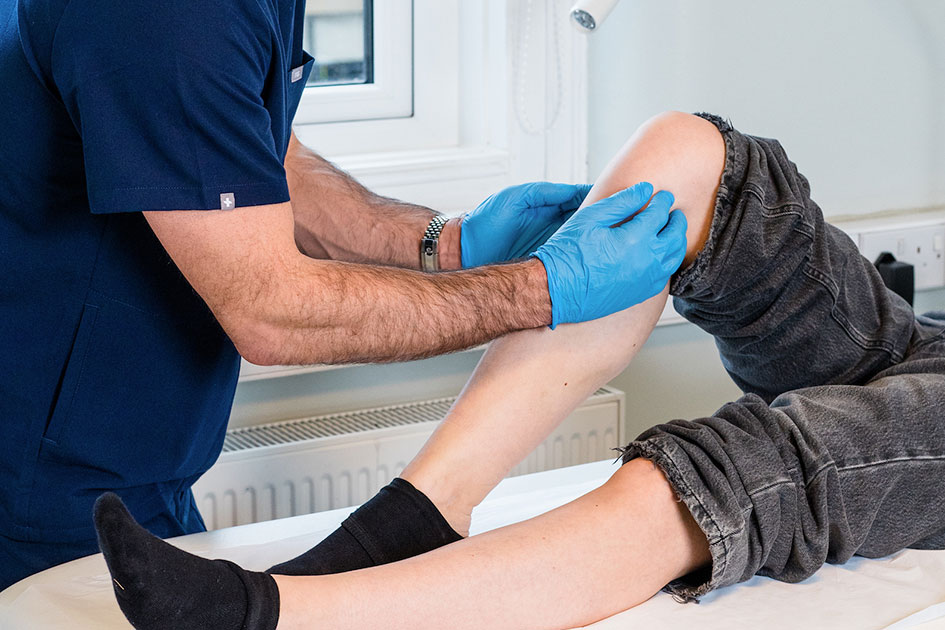


We offer private cortisone injections both with ultrasound guidance for accuracy and without ultrasound guidance. If you do not have a referral letter, book an initial consultation first and we’ll assess your joint and suitability for injection. We can also perform a Hylauronic acid (Ostenil) injection in certain patients.
If you do not have a referral letter for your joint injection and have not been assessed already by a doctor or physiotherapist then Dr Russell, Dr McKeown or Dr Blessing Ogbobi, must see you for an initial examination and consultation.
Please share this via email with reception in advance of your appointment.
This a 30 minute appointment and suitable for:
Which doctor should I choose?
Depending on the area required, please select the most appropriate doctor when booking your appointment.
Please share this via email with reception in advance of your appointment.
The is a 60 minute appointment and suitable for:
This appointment is available with Dr Tim Russell only.
This injection is not routinely advised for OA, because the evidence from large studies does NOT show long term benefit. However in some individuals benefit has been documented.
We require a referral letter for an Ostenil injection or if you have seen us before and we recommended this.
Please share your referral via email with reception in advance of your appointment so we can order the Ostenil in to the clinic
The is a 60 minute appointment
It is suitable for anyone with:
ℹ️ This injection is done under ultrasound guidance for the knee and base of the thumb with Dr Tim Russell. We do not inject other joints.
See below under frequently asked questions for more information.
*If a second joint requires injection during the same appointment, an additional fee of £150 applies.
If you are taking warfarin (a blood thinner) we cannot do a joint injection.
We cannot do the spinal joint.
Dr Rory McKeown can perform injections for knee and shoulder only without USS guidance.
Dr Blessing Ogbobi can perform injections for knee, shoulder and greater trochanter conditions without USS guidance.
Dr Tim Russell can perform injections for all areas listed, with or without USS guidance.
An aftercare information sheet is sent by email following all procedures. This covers rest, rehabilitation exercises and any recommended supplements or support.
Read our FAQs below for more information or call us on 028 9691 3000


Verified Google reviews from patients who’ve experienced our personalised care.
All our doctors are NHS-trained, GMC registered, and passionate about supporting patients in achieving long-term health improvements.



GP
Dr Russell joined Vitalis Health in 2021 bringing his experience as an NHS GP and personal interest in mind body medicine to the clinic.
Dr Tim has a diploma in Lifestyle Medicine from the British Society of Lifestyle Medicine. As an extension of this he has a particular interest in treating disease through lifestyle modification – especially in areas where psychological problems, such as stress, contribute towards physical problems such as high blood pressure, headaches, fibromyalgia and Irritable Bowel Syndrome (IBS).
He is also skilled in performing joint injections and has a lot of experience dealing with difficult to manage eczema and dermatitis.
He graduated in Medicine from the University of Newcastle-Upon-Tyne in 2000. After working in various hospital specialties in England, New Zealand and Scotland, he qualified as a GP in 2006.
Alongside his Vitalis Health role, Dr Russell continues to work as an NHS GP partner in Northern Ireland.
GP
Dr McKeown has over 20 years experience as a doctor. He skilled in performing minor operations such as mole and sebaceous cyst removals which he does on Mondays and Wednesdays. He is also trained in skin mole examination using a dermascope. Dr McKeown is an attentive and compassionate GP.
In his spare time he enjoys an active lifestyle, and believes in preventative medicine through lifestyle modification such as exercise, diet and stress reduction. Dr McKeown also believes that patients should have a doctor who supports them during their health journey.
GP
Dr Blessing is a GP in Belfast with 7+ years experience working in NHS general practice.
Alongside general consultations, she also performs steroid injections for knee, shoulder and greater trochanter conditions. She is also currently furthering her professional development with training in ultrasound-guided injections.
Holistic, patient-centred care is important to Dr Blessing, and she strives to look beyond the presenting complaint to support her patients’ overall health and wellbeing.
Outside of clinical practice, she enjoys playing Padel and spending time with her young family.
Regular GP care? Our membership plans offer discounted appointment rates, priority booking, and annual health checks.

We’ve answered the most common questions about joint steroid and cortisone injections below. If you don’t find what you’re looking for, our team is happy to help.
This appointment requires an initial 30 minute consultation, if you haven’t seen someone before for your joint problem and do not have a referral letter.
The GP will assess your painful joint or joints and decide if a steroid injection will benefit you. They may refer you for a scan of the joint, recommend some blood tests, and will guide you with exercises to prevent the problem happening again.
We may also recommend you see a physiotherapist.
The most common reason to have a cortisone or steroid joint injection is severe debilitating pain that does not respond to medication or rubs, interferes with sleep and is getting worse despite other treatments such as physio therapy.
Guidance from The British Society of Rheumatology can be read here. Guidelines vary between countries, but as with any cortisone injection either into a joint, tendon area or muscle, the potential risks and benefits should always be carefully considered.
Joint injections are also known as ‘Cortisone-injections’, or ‘Steroid-injections’.
They are performed by rheumatology doctors, orthopaedic surgeons, GP’s who have been trained in this procedure and also by some physiotherapists.
At Vitalis Health Dr Russell, and Dr McKeown perform these injections. Dr Russell can perform these under Ultrasound guidance to visualise needle and steroid placement.
One of the most common reasons to have a steroid joint injection is because of pain from arthritis of the joint, either Rheumatoid arthritis, osteoarthritis, or another type of inflammatory arthritis such as psoriatic arthritis.
Other reasons for a steroid injection are swelling or inflammation of a tendon that is not settling with physio and strengthening exercises, and pain where the muscle inserts into the bone such as Tennis or golfers Elbow.
Some people will have a bursitis or capsulitis which requires a steroid injection to settle inflammation.
Steroids are used to reduce swelling and pain, and improve movement of the joint. If you have an inflammatory arthritis like rheumatoid then you will probably also take a medication to reduce inflammation – a steroid injection is used only when there is a bad flare-up of your joint pains.
In the case of osteoarthritis, there is no licensed medication to reduce the disease progressing, although diet and exercise can help, so often a steroid injection is used to alleviate pain. We do not like to do repeated injections for OA as the effects can become short lived and the steroid can effect the integrity of the joint cartilage that is there. It’s important to discuss this with the doctor.
Tendon pain can be sudden (acute) or longstanding (chronic). Both these types respond very differently to steroid injections, but always need some amount of strengthening exercises to ensure the abnormal tendon changes into a healthier tendon with the correct stimulation.
Tennis and golfers elbow are not true tendon injuries, though they do respond similarly to both exercise and steroid injection.
De Quervains tenosynovitis is a common problem for women who are either pregnant or have just given birth and it does respond well to a steroid injection.
Our GPs will assess you joint or tendon and decide on the best treatment plan. Sometimes a steroid injection will do more harm than good and it is important to consider other options.
Most injections of the knee, elbow or shoulder take approximately 45 minutes to perform.
The first 10 minutes are for asking you questions about your joints/tendons and your general health, then 10 minutes to assess the joint to ensure an injection is suitable. After that if the procedure is necessary and you will benefit, a consent form will be provided.
The area to be injected will be prepared so that it is clean and sterile. Iodine is used to clean the skin and allowed to dry for 5 minutes. The joint or tendon injection itself, takes 10 minutes which allows for the local anaesthetic to work; however, if there is fluid in the joint this will be removed which can take an additional 10 minutes.
Usually joint injections cause a little discomfort initially as the local anaesthetic is being injected, then after that you may feel some pressure only.
It is important to let your doctor know if you think the anaesthetic is not enough.
There can be some pain one hour after the injection when the local anaesthetic wears off, but this is often minimal and sometimes there is no pain at all.
Infection is a rare but possible side-effect of a cortisone injection. Let the doctor know if you start to feel unwell or are in pain.
Dr Tim Russell and Dr Rory McKeown are highly skilled in performing joint injections.
Dr Russell has been doing joint injections for over 18 years. He uses the anatomy landmarks to guide his injection and is confident with knee steroid injections, carpel tunnel, tennis elbow and shoulder injections.
Dr McKeown performs injections of the knee and shoulder with landmark guidance. Dr McKeown was an A&E doctor for some years before becoming a GP and so has experience in taking fluid off swollen knees and also performing knee cortisone injections.
If a joint injection is not needed, either because it may not help or in some cases could cause other problems, our GPs will explain this to you and offer an alternative treatment. A consultation fee of £140 will be charged.
For injections of the hip or the back, we will refer you to have this done under X-ray or Ultra-sound guidance.
Steroid injections can thin-out the joint lining and in some cases result in an infection of the joint, or more rarely collapse the joint structure if there is severe arthritis underlying.
Other side effects are pain after the procedure once the local anaesthetic wears off, and very rarely you can paradoxically develop a flare-up of your arthritis due to the steroid crystallising in the joint.
Steroid or cortisone injected into the joint is absorbed by the rest of your body and can theoretically increase your risk of other infections if high doses are used.
Each person responds differently to steroids. Rarely, steroids can cause the adrenal glands where your natural steroid is produced to stop doing their job which can increase your risk of infection if this is not picked-up by your doctor.
Not all tendons benefit from a steroid injection and in some cases if the tendon is weak and stiff from chronic inflammation the steroid injection can result in the tendon breaking or tearing.
It is important to be properly assessed by your doctor to decide if an injection is likely to benefit you and to weigh up the possible side-effects.
In some cases an X-ray of the joint is required first and our GPs will refer you for this if needed. (You can usually have the X-ray performed that day in Belfast).
The doctor will explain the following and send you an after care information sheet by email.
Dr Graham first worked in the specialty of Rheumatology in 2004 as a staff grade in Antrim Area Hospital, then again in 2007 as a Rheumatology Registrar in the Leicester Royal Infirmary and in Antrim Area as a staff grade in 2008.
Finally while still working as a GP, she returned to Rheumatology In 2015 to work in Musgrave Park Hospital, Belfast as a staff grade doctor in Rheumatology. During this time she set the foundations for her research in Sport & Exercise Medicine and the following year she was granted approval to carry out research into the effects of exercise on women with rheumatoid arthritis.
Her research was conducted through Musgrave Park Hospital Rheumatology Department, and in 2016 she obtained her Masters Degree in Sport & Exercise Medicine, graduating from the University of Bath.
While Dr Graham doesn’t work clinically at present, she imparts her wealth of knowledge and years of experience with the Vitalis Team.
There are other substances that can be injected into the joint for OA.
Hyaluronic acid. The use of any intra-articular Ostenil formulation is not routinely used in our clinic due to the lack of evidence demonstrating benefits over placebo injection.
There has been a longstanding debate and conflicting data across different trials regarding the benefit of hyaluronic Acid injected into the joint space for the treatment of symptomatic knee OA.
Overall the evidence from large, double-blinded, and high-quality trials indicates that intra-articular hyaluronic Acid has a small, but clinically irrelevant benefit over intra-articular placebo. The other thing we consider is the that intraarticular hyaluronic Acid is associated with high costs and potential side effects such as pain flare-ups and small incidence of joint infections.
We can perform this injection instead of a cortisone injection to assess your individual response but it is not routinely used in our clinic. The cost is an additional £50 to the standard joint injection fee, which is included in the price above.
Platelet-Rich Plasma (PRP) – This is most often used in someone with tennis elbow or a tendonitis that is not improving with routine strength training, friction massage and ESWT (Electric shock Wave Therapy) treatments.
At Vitalis Health we do not use PRP injection in patients with knee OA, due to the lack of solid evidence for its benefit.
Mon: 8:15am – 4:30pm
Tue: 8:30am – 4:30pm
Wed: 8:15am – 4:30pm
Thur: 8:30am – 4:30pm
Fri: 8:30am – 4:30pm
Sat – Sun: Closed


